The Railroad Modeler Is Now Closed! Please Visit
Our New Site RAILS WEST
Showing posts with label Norfolk and Western. Show all posts

Saturday, November 28, 2009

Bachmann HO Scale 4-8-4 J Class Northern Locomotive - Norfolk & Western

Bachmann HO Scale 4-8-4 Class J Locomotive w/Dog House on tender, Norfolk & Western / w extra water tank car #608

Product Features

DCC ready
Operating headlight
Separately applied detail parts
Alligator cross heads


Product Description

The Class J 4-8-4 was the last mainline steam locomotive to run in the United States. Designed for optimum speed, the “J” once reached 115 mph during a land speed test until a hesitant engineer closed the throttle.
The design of the Js was completely universal. They were equipped with 300 psi boilers, 70" drivers, and roller bearings on all wheels and rods. The 70" drivers and 300 psi boiler allowed for a higher tractive effort. When operating at maximum psi, the Js delivered 80,000 lbf of tractive effort-the most powerful for 4-8-4 wheel arrangement locomotive without a booster. The engineers designed the J class not to pull freight, but passengers, and at a high speed. The 70" drivers were very small for a locomotive that was to pull trains at over 100 mph. To overcome this, the wheelbase was made extremely rigid, lightweight rods were used, and the counterbalancing was extremely good. As delivered, the Js had duplex (two) connecting rods between the primary (second) and third drivers, but in the 1950s N&W's engineers apparently decided they could do without these and 611 and at least one other Class J were rebuilt with a single connecting rod. The negative effect of the J's highly engineered drivetrain was that it made the locomotives very picky about good trackwork. Her counterbalancing and precision mechanics were so state of the art that it is often said that the J's top speed is only limited by the nerves of the engineer. Judging by their performance in hauling a 10 car 1050 ton train at speeds in excess of 110mph over Pennsylvania Railroad's "racetrack", the Fort Wayne Division, while on loan, it is hard to argue that claim.
The Js were the pride of the N&W, pulling passenger trains such as "The Powhatan Arrow", "Pocahontas", and "Cavalier", as well as ferrying Southern Railway's "Tennessean" between Monroe, Virginia and Bristol, Tennessee. While on test on the Pennsylvania Railroad, number 610 proved that a J could pull ten cars at 110 mph along a section of flat, straight track. Despite the power and speed capabilities the Js were among the most reliable engines, running as many as 15,000 miles per month, even on the mountainous and relatively short route of the N&W.

Bachmann Spectrum HO Scale 4-8-2 Mountain Locomotive - Norfolk & Western

Bachmann Spectrum HO Scale 4-8-2 Mountain Locomotiv w/DCC & Sound, Norfolk & Western #118


Product Description

This Norfolk & Western USRA Heavy Mountain 4-8-2 Steam Locomotive (#118) is a / DCC Sound-Equipped Spectrum® Model by Bachmann®. / Suitable for Ages 8 & Older. / / FEATURES: Equipped with DCC On Board® technology, which allows you to / digitally control the direction, speed, and lighting of this / locomotive using Bachmann's E-Z Command® Digital Command Control / System (BACU4402), or any NMRA-compliant DCC system. / The decoder itself features the following: / * 2 and 4 digit addresses / * advanced consisting / * dimmable lighting / * settable acceleration, decleration, / starting speed, and much more! / 100% backwards-compatible with standard DC (non-digital) layouts. / Equipped with a 28-speed step decoder. / Main track programming. / Also equipped with a state-of-the-art Digital Sound Decoder that's / based on SoundTraxx® Tsunami® Digital Sound Technology. The / decoder has been designed with a powerful Digital Signal / Processor (DSP) and: / * Supports extended address mode for assigning any / locomotive number up to 9,999 / * Supports advanced consist addressing / * Supports "Operation Mode Programming," allowing CVs to / be changed on the mainline without using a programming / track / The automatic dual mode decoder is set to operate immediately / using either a 12 volt DC power pack or NMRA-compatible / DCC command station. / Many advanced throttle features including: / * Programmable acceleration, deceleration and starting / voltage for prototypical starting and stopping / * Use of standard and alternate speed tables / The 16-bit sound processor provides: / * Adjustable volume control of each sound effect individually / * 1-watt audio amplifier / * Auto-Exhaust allows chuff to be synchronized to the locomotive / speed without the complexity of a synchronizing cam / All of the steam sound effects have been re-mastered and re-digitized / for the best audio possible: / - Steam Exhaust Chuff - Airpump / - Bell - Dynamo

The Norfolk and Western Railway (N&W) (reporting mark NW), a US class I railroad, was formed by more than 200 railroad mergers between 1838 and 1982. It had headquarters in Roanoke, Virginia for most of its 150 year existence.

The company was famous for manufacturing steam locomotives in-house at the Roanoke Shops as well as their own hopper cars. Around 1960, N&W was the last major American railroad to convert from steam to diesel motive power.

In the mid 20th century, N&W merged with long-time rival Virginian Railway in the Pocahontas coal region and grew even more in size and profitability by mergers with other rail carriers including Nickel Plate Road and Wabash in adjacent areas to form a system serving 14 states and a Canadian province between the Atlantic Ocean and the Mississippi River and Great Lakes with more than 7,000 miles (11,000 km) of trackage.

In 1982, the Norfolk & Western Railway was combined with the Southern Railway, another profitable carrier, to form the Norfolk Southern Corporation (NS), but it continued paper operations until it was merged into the Southern (by this point renamed Norfolk Southern Railway) in 1997.

See Also: Broadway Limited HO Scale 2-6-6-4 Class A Locomotive - Norfolk & Western / Bachmann Spectrum 2-8-0 Consolidation HO Scale Locomotive - Rock Island

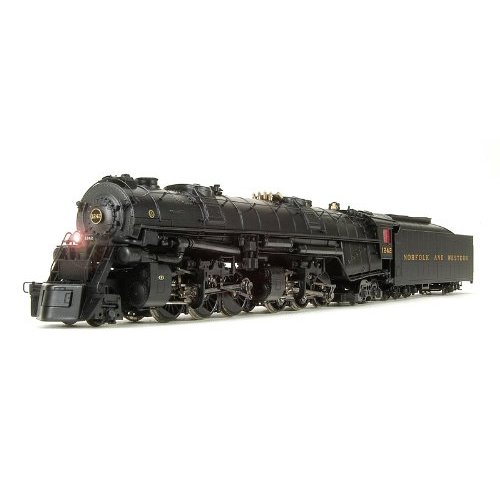
Broadway Limited HO Scale 2-6-6-4 Class A Locomotive - Norfolk & Western

Broadway Limited HO Scale Blue Line 2-6-6-4 Class A Locomotive w/Sound, Norfolk & Western #1235
Product Description

HO Blue Line 2-6-6-4 Class A w/Sound, N&W #1235


In the Whyte notation for the classification of steam locomotive wheel arrangement, a 2-6-6-4 is a locomotive with a two-wheel leading truck, two sets of six driving wheels, and a four-wheel trailing truck. All 2-6-6-4s have been articulated locomotives, of the Mallet or related simple articulated type.
The 2-6-6-4 was a fairly late development, a product of the superpower steam concept, introduced by the Lima Locomotive Works, which encouraged the use of large fireboxes supported by four-wheel trailing trucks. Such a firebox could sustain a rate of steam generation to meet any demands of the locomotive's cylinders, even at high speed. High speeds were certainly among the design goals for a 2-6-6-4; most of the type were intended for use on fast freight trains.
The first 2-6-6-4s built in the United States were for the Pittsburgh & West Virginia Railroad, and these were not high speed locomotives but rather heavy mountain luggers. They received three in 1934 and four more in 1937.
The final class of 2-6-6-4s was the Norfolk & Western Railway's Class A, built starting in 1936. 43 were built until 1950. They were the largest and most powerful 2-6-6-4s, capable of 6,300 drawbar horsepower (4.7 MW) at 45 mph (72 km/h) and able to run at over 70 mph (110 km/h), but were also capable of lugging heavy unit coal trains. They were used until dieselisation in 1959. One locomotive, Norfolk & Western 1218, was preserved and in 1987 was restored to running order, running on frequent excursions until 1991. Today it is on display at the Virginia Museum of Transportation.