The Railroad Modeler Is Now Closed! Please Visit
Our New Site RAILS WEST
Showing posts with label Canadian National. Show all posts

Monday, November 30, 2009

Trainline HO Scale EMD GP-9M Locomotive - Canadian National

Trainline HO Scale EMD GP9M Locomotive Ready-to-Run - Canadian National

ONE OF OUR MOST REQUESTED LOCOMOTIVES!

Product Features

Ready to Run
Dual Fly Wheels
Knuckle Couplers
Diecast Metal Frame
Quality construction and features


From the Manufacturer

The Electro-Motive Division (EMD) of General Motors was the last major builder to enter the road switcher market, introducing the GP7 (GP for General Purpose) in 1949. In 1954, the more powerful GP9 was unveiled with a 1750 horsepower prime-mover. This became the most successful of the early geeps, with sales of more than 3,800 locos in the U.S. and Canada. As the GP9s were bumped from major freight and passenger trains by newer locos, they began new careers as switchers. Many roads rebuilt them with a low nose to improve forward visibility and they continue to serve in switching, wayfreight and transfer assignments today. This HO Scale model will be a real workhorse on your model railroad, with great features like a heavy diecast metal frame, powerful can motor with flywheel, eight-wheel electrical pick-up and drive, and a working headlight. Fully assembled and ready for service, they come prepainted in a variety of schemes.

An EMD GP9 is a four-axle diesel locomotive built by General Motors' Electro-Motive Division in the United States, and General Motors Diesel in Canada between January, 1954, and August, 1963. US production ended in December, 1959, while an additional thirteen units were built in Canada, including the last two in August, 1963. Power was provided by an EMD 567C sixteen-cylinder engine which generated 1,750 horsepower (1.30 MW).[1] This locomotive type was offered both with and without control cabs; locomotives built without control cabs were called GP9B locomotives. All GP9B locomotives were built in the United States between February, 1954, and December, 1959.

A total of 3,444 units of this locomotive model were built for American railroads, with an additional 646 for Canadian railroads and ten for Mexican railroads. Five units were built for a railroad in Brazil, four units were built for a railroad in Peru and six units were built for a railroad in Venezuela. Of the GP9B, 165 examples were built for American railroads.

There were 40 GP9M units built that are included in the 3,444 units built for United States railroads. A GP9M was built with parts from another older EMD locomotive, either an F unit or a damaged GP7. The use of parts from these older locomotives caused the GP9Ms to have a lower horsepower rating than a GP9. This would be either 1,350 horsepower (1.01 MW) if the donor locomotive was an FT/F2 or 1,500 horsepower (1.12 MW) from F3/F7/GP7 locomotives.

Many rebuilt GP9s remain in service today with shortline railroads and industrial operators. Some remain in rebuilt form on some major Class I railroads, as switcher locomotives. Canadian Pacific Railway and Canadian National Railway still have many in their fleets in 2007 as switcher locomotives.

See Other Canadian National Locomotives: Bachmann HO Scale 2-6-0 Mogul Locomotive - Canadian National

See Other GP-9M Locomotives: Trainline EMD GP9M HO Scale Locomotive - Burlington Northern / Trainline EMD GP9 HO Scale Locomotive - Rio Grande

See More Canadian National Railway News Stories: Talks Between CN And Locomotive Engineers' Union In Canada Break Off With No Settlement / CN Receives Strike Notice From Union Representing Locomotive Engineers In Canada / CN To Implement Wage Increase And Milage Cap For It's Canadian Engineers / CN Reaches 20th Voluntary Mitigation Agreement (VMA), Makes Substantial Strides In EJ&E Integration

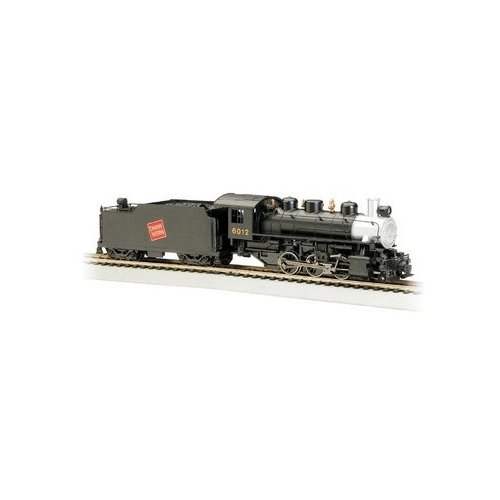
Bachmann HO Scale 2-6-0 Mogul Locomotive - Canadian National

Bachmann HO Scale Ready To Run 2-6-0 Mogul Locomotive w/Tender & Smoke, Canadian National #6012

Product Features

Features operating headlight and smoke
Extra smoke oil included


Product Description

This HO Scale 2-6-0 Mogul Locomotive and Tender / (Canadian National #6012) is by Bachmann Trains. / / FEATURES: Compatible with any HO scale electric track and equipment. / Working headlight on the locomotive. / Locomotive is painted black with a silver front boiler section and / gold bell and whistle. 6012 in gold on each side. / Tender is painted black with the Canadian National logo in red and / gold. / Tender carries a realistic coal load. / Standard black plastic couplers. / Black and silver metal drive wheels on locomotive; black plastic / wheels on tender. / Working smoke unit with included smoke oil. / Operation manual provided. / Lifetime limited warranty on Bachmann locomotives. / / INCLUDES: One HO Scale 2-6-0 Mogul Locomotive and Tender (Canadian National). / REQUIRES: HO Scale Train Equipment / / SPECS: Scale: HO 1:87 / Locomotive Size - Tender Size - / Length: 5-1/4" (133mm) Length: 4-1/4" (108mm) / Width: 1-3/8" (35mm) Width: 1-3/8" (35mm) / Height: 2" (51mm) Height: 1-5/8" (41mm) / sdw 6/13/02 / ir/kh

In the Whyte notation for the classification of steam locomotives by wheel arrangement, a 2-6-0 has a pair of leading wheels followed by six driving wheels. This arrangement is commonly called a Mogul.[1] In the United States, this type of locomotive was widely built from the early 1860s to the 1920s.

Although locomotives of this wheel arrangement were built as early as 1852, these first examples had their leading axles mounted directly and rigidly on the frame of the locomotive rather than on a separate truck or bogie. In these early 2-6-0s, the leading axle was merely used to distribute the weight of the locomotive over a larger number of wheels. It did not serve the same purpose as the leading trucks of the Americans or Ten-Wheelers that had been in use for at least a decade.

The first 2-6-0 with a rigidly mounted leading axle was the Pawnee, built for heavy freight service on the Philadelphia & Reading. In total, about 30 locomotives of this type were built for various railroads. While they were generally successful in slow, heavy freight service, the railroads that used them didn't see any great advantages in them over the 0-6-0 or 0-8-0 designs of the time. Essentially, this design was an 0-8-0 with the lead axle unpowered.

The first true 2-6-0 wasn't built until the early 1860s, the first few being built in 1860 for the Louisville & Nashville railroad. The design that we know today required the invention of a single-axle swivelling truck. Such a truck was first patented by Levi Bissell in 1858. The New Jersey Locomotive and Machine Company built their first 2-6-0 in 1861 as the Passaic for the Central Railroad of New Jersey. The Erie Railroad followed in 1862 with the first large order of this locomotive type. In 1863, Rogers built what some cite as the first 2-6-0 built in the United States for the New Jersey Railroad and Transportation Company. It is likely that the locomotive class name Mogul derives from a locomotive built by Taunton in 1866 for the Central Railroad of New Jersey; that locomotive was named Mogul. However it has also been suggested that, in England, it derived from the engine of that name, built in 1879 by Neilson and Company for the Great Eastern Railway.

Canadian National Railroad News Items: Talks Between CN And Locomotive Engineers' Union In Canada Break Off With No Settlement / CN Receives Strike Notice From Union Representing Locomotive Engineers In Canada / CN To Implement Wage Increase And Milage Cap For It's Canadian Engineers / CN Reaches 20th Voluntary Mitigation Agreement (VMA), Makes Substantial Strides In EJ&E Integration